Analogowy Inżynier • Essay
I Don’t Think as I Write, Therefore I Am
Or how a typo became proof of existence in the age of artificial intelligence
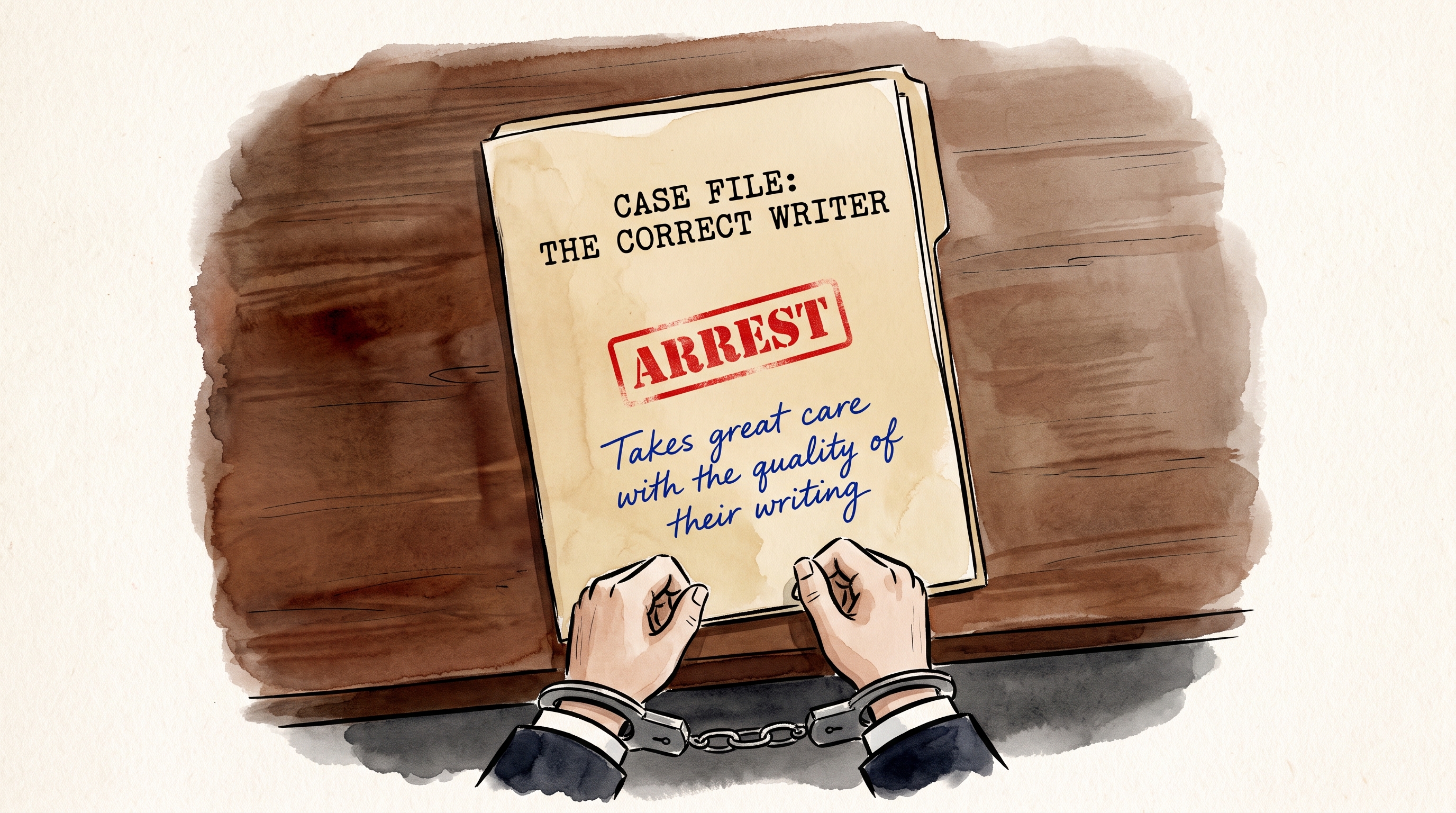
We live in fascinating times, where a solid command of the writing craft has become an incriminating circumstance. If your text is free of typos, your commas land precisely where syntax dictates, and you occasionally dare to use a colon or an em-dash—watch your back. In the eyes of self-appointed AI sleuths, you are already practically exposed. You don’t simply write well. You exhibit a suspicious, inhuman “sterility.”
The internet has recently been flooded with guides offering tips on how to tell human writing apart from algorithm-generated text. Their authors—often boasting editorial backgrounds—argue with disarming seriousness that an absence of errors and a tidy structure are now red flags. Worse still, today’s digital oracles, which attempt to measure the percentage of a human soul left in a text, fall into the exact same trap. Algorithmic AI detectors treat stylistic smoothness and predictable, proper syntax with cold precision as proof of machine origin.
According to this revolutionary new doctrine, a true author—one who is human—is recognized precisely by a lack of respect for both the reader and themselves. The typo has been promoted to a “Homo sapiens badge of honor,” and chaotic punctuation has become the purest proof that a living being is sitting on the other side of the screen.
It is hard to imagine a more naive—or more corrosive—thesis.
The Paranoia of Perfection and an Alibi Made of Errors
The effects of this new paranoia are already visible to the naked eye. Students, journalists, and copywriters increasingly have to prove they are not robots—showing document version histories or justifying themselves to clients simply because their sentences are too well-structured. Instead of taking pride in a job well done, writers find themselves nervously scanning their own drafts for places to intentionally “mess things up,” just so they don’t sound too polished.
Elevating the linguistic sloppiness so common in online comment sections to the gold standard of “human style” is, in essence, an attempt to enforce a dangerous race to the bottom. For centuries, care for spelling, precision of word choice, and clear sentence structure were proof of mastery over form and language. Today, some would have us believe these very traits signal the absence of a human element.
It is a bizarre logic in which a brilliant essayist and an impassive text generator end up in the same dock, while the only alibi is a lack of proofreading.
The Illusion of Defending Against the Machine
Moreover, this entire defensive strategy rests on a fundamental misunderstanding of the technology it supposedly protects against. The belief that a mistake in a text guarantees its authenticity is touchingly defenseless against the fact that giving a language model the prompt: “make this sound more casual and throw in three typos” takes roughly three seconds.
If our only line of defense against a flood of machine-generated content is deliberately degrading our own language, we have lost this battle before it has even begun.
The real problem with algorithm-generated texts isn’t that they are grammatically correct. It is that they are safe, smooth, and transparent. A machine can assemble sentences brilliantly, simulate emotions, and replicate experiences. Yet it cannot vouch for them in its own name. It has no personal history from which a human perspective grows, nor any personal stake in the argument it enters. Nor does it bear responsibility for the consequences of the judgments it voices.
And right here lies the crucial boundary.
Courage Over Sloppiness
What truly separates a human author from an algorithm is not a stray letter or a misplaced comma. It is sharpness of thought, an unexpected association, personal experience, and above all—the courage to take a clear stand and invite pushback.
True style is not born out of ignorance of the rules, but out of their complete mastery. Only then can you break them deliberately to achieve an intended effect, rather than hiding behind sloppiness as proof of your humanity.
In an era of ubiquitous automation, we do not need to pretend to write worse in order to prove we exist. On the contrary—the only sensible answer to algorithmic mediocrity is even greater precision, discipline of thought, and respect for language. Sloppiness is not, and never will be, proof of authenticity.
I wonder—after reading this piece, did you pause for even a second to ask yourself whether it was written by artificial intelligence (after all, there are em-dashes in it)?
And finally, perhaps the most intriguing question of all: if a human deliberately imitates an AI’s style, is the detector actually detecting AI—or merely its own preconceptions about what machine-generated prose looks like?